
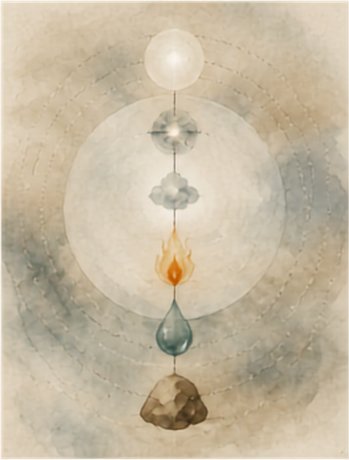
The Creation: A Sankhya Perspective
Before the Panch Mahabhutas
The Story of Creation
When we encounter topic of the Panch Mahabhutas,(The Five Great Elements) it is easy to assume that the story of creation begins with them
Earth, Water, Fire, Air and Space appear tangible enough to serve as the building blocks of reality.
Yet Sankhya invites a different possibility.
Before there is a world, before there are elements, before there is even an individual to experience them,
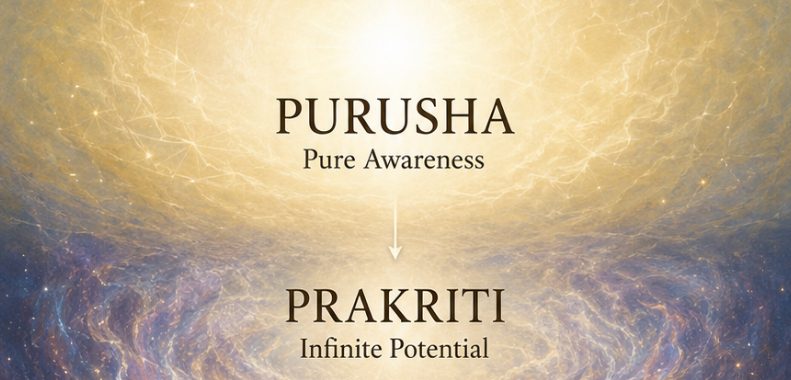
there is Purusha.
Purusha and Prakriti
Purusha is one of those words that resists simple translation. It is often rendered as consciousness, but even that feels incomplete. When we use the word consciousness today, we usually mean awareness of something. Awareness of a thought, a sensation, a memory, a sound.
Purusha is not awareness directed toward an object.
It is awareness itself.
Silent. Unchanging. Untouched by whatever appears within it.
The sages described it not as something that acts, creates or transforms, but as that by which all experience becomes possible.
Alongside Purusha stands Prakriti.
If Purusha is pure awareness, Prakriti is pure potential.
Everything that can ever become manifest rests within it, in an unexpressed state. Form, movement, matter, energy, thought, sensation, memory, emotion, the stars above and the earth beneath our feet—all lie dormant within Prakriti before creation begins to unfold.
One might think of a seed.
A tree is not yet visible within the seed, yet the possibility of roots, bark, leaves, flowers and fruit already exists there. Prakriti contains the entire universe in such a latent condition.
When Purusha and Prakriti are spoken of together, they are often described as consciousness and nature. Witness and potential. Presence and becoming.
From this relationship arises the first movement toward manifestation.
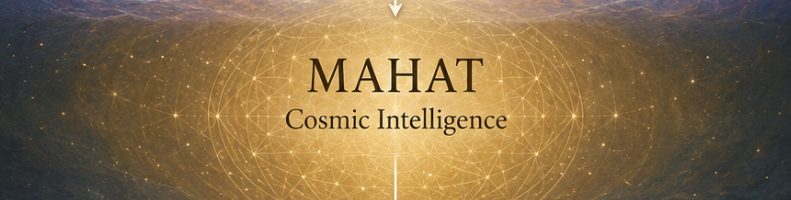
This first emergence is called Mahat.
Mahat
Mahat is often translated as cosmic intelligence, but perhaps it can be approached more simply.
Before there are individual minds, there is order.
Before there are personal thoughts, there is intelligibility.
The universe unfolds according to patterns rather than chaos. Seasons return. Seeds become trees. Galaxies form. Life organizes itself.
Mahat refers to this primordial intelligence woven into creation itself. It is the principle that allows the universe to become knowable.
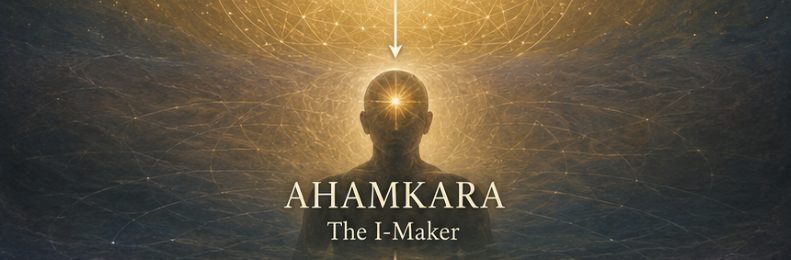
From Mahat arises Ahamkara.
Ahamkara
AHAMKAR is word that suffers from translation. Translated as EGO in english.
Today ego is often understood as arrogance or self-importance. Ahamkara means neither.
Literally, it means “I-maker.”
It is the principle through which experience begins to gather around a centre. Without Ahamkara there is experience, but no one to whom the experience belongs.
With Ahamkara comes the sense of “I see,” “I think,” “I feel,” “I want.” Individuality begins to emerge.
The vast field of manifestation now starts organizing itself through countless centres of experience.
Only after this do the Tanmatras appear.
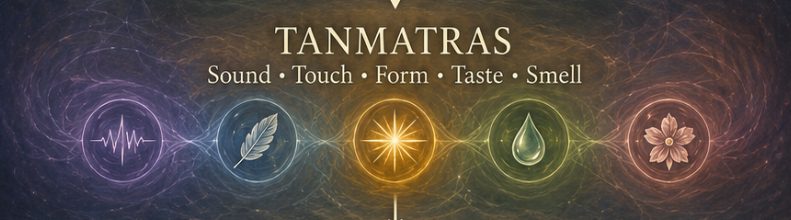
The Tanmatras
The Tanmatras are among the most fascinating ideas in the entire tradition.
They are often described as subtle elements, though that translation can be misleading. The Tanmatras are not yet the world we know.
They are not sound, but the possibility of sound, of touch,of form, of taste, of smell.
The sages seem to suggest something extraordinary here.
Before there are objects to be perceived, there exist the fundamental potentials through which perception itself becomes possible.
Before there is music, there is the possibility of hearing.
and so.
The world does not emerge first and then become experienced. Experience and manifestation unfold together.
From these subtle potentials arise the Mahabhutas, the great elements.
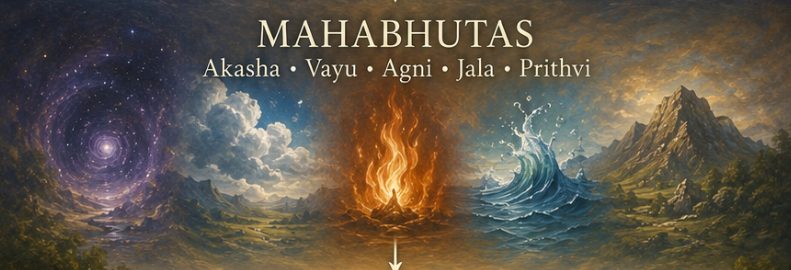
The Mahabhutas
Earth, Water, Fire, Air and Space are therefore not merely physical substances scattered throughout nature.
They are the visible expressions of principles that have been unfolding from the very beginning of creation.
By the time the Mahabhutas appear, the universe has already travelled a long journey—from pure awareness, to potential, to intelligence, to individuality, to the subtle architecture of experience itself.
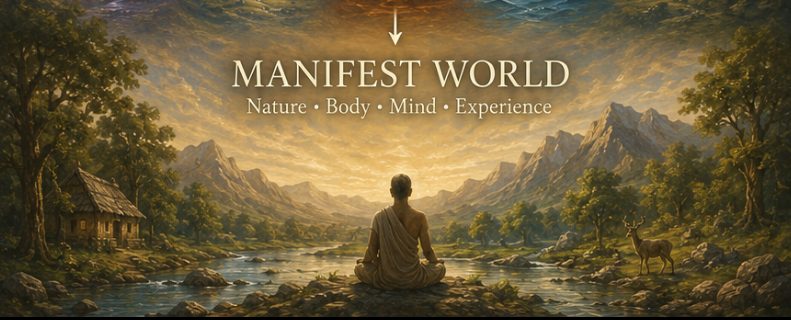
The elements are not the beginning of the story.
They are the moment the invisible begins to take form.
Read the Panch Mahabhuta Series
- The Creation: A Sankhya Perspective (you are here)
- Jal: The Water Element
- Agni: The Fire Element
- Vayu: The Air Element
- Akasha: Space, Ether
- Prithvi: The Earth Element