

Akasha: Space, Ether
The Meaning of Akasha
Imagine trying to play music without silence between the notes, or holding a conversation without pauses between sentences.
Space is rarely noticed because attention naturally falls upon the objects it contains. Yet remove space, and every structure, every movement, and every interaction becomes impossible.
This insight forms the foundation of Akasha- subtlest of all elements—the one that accommodates every other form of existence.
Unlike modern scientific descriptions of space, which focus on measurable dimensions, Akasha carries philosophical and experiential significance. It points toward openness, possibility, and the absence of obstruction. It is as relevant to the inner world of thought as it is to the outer world of physical existence.
Understanding the Fifth Element
Across cultures, the natural world has often been understood through a small number of fundamental principles that explain both the universe and the human experience. In the Indian yogic tradition, these principles are known as the Panch Mahabhutas—Earth (Prithvi), Water (Jala), Fire (Agni), Air (Vayu), and Akasha.
Among them, Akasha is perhaps the most intriguing. It has no shape, colour, weight, or texture. It cannot be contained, divided, or possessed. Yet classical yogic philosophy considers it the most fundamental of the five elements, for without it the others could not exist.
Akasha is commonly translated as space or ether. Akasha, however, represents the principle that allows matter, energy, sound, movement, and life itself to exist
It is both the field in which creation unfolds and the openness that makes all relationships possible
Akasha in the Panch Mahabhutas
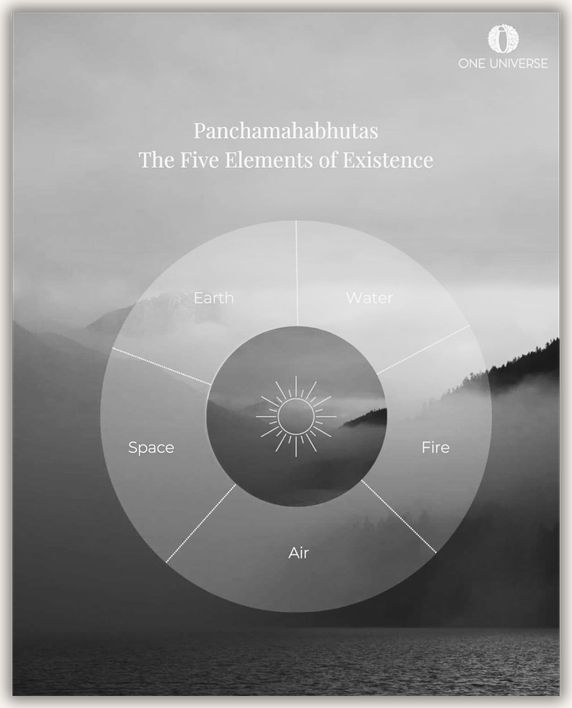
According to yogic philosophy, the material universe is composed of five elemental principles known as the Panch Mahabhutas. These are not chemical elements but archetypal qualities that describe the behaviour and characteristics of all forms.
- Earth represents solidity, stability, and structure.
- Water embodies fluidity, cohesion, and adaptability.
- Fire signifies transformation, heat, and illumination.
- Air expresses movement, change, and mobility.
- Akasha provides the space within which all these processes occur.
The order is significant.
Akasha is regarded as the first and subtlest manifestation. From space emerges movement; from movement comes heat from heat arises liquidity; and finally, condensation gives rise to solidity.
The progression moves from subtle to dense, suggesting that the visible world is the culmination of deeper and less tangible principles.
Akasha and Sound

One of the distinctive features of Akasha is its association with sound.
In yogic philosophy, each element corresponds to a sensory experience. Earth is linked with smell, water with taste, fire with sight, air with touch, and Akasha with hearing.
Sound requires space to propagate. Whether through air, water, or solid materials, vibration depends upon a medium and an environment within which it can travel.
This association also explains the importance of sacred sound within many contemplative traditions. Mantras, chanting, and attentive listening are viewed not merely as devotional practices but as methods of refining perception.
They remind practitioners that sound emerges from silence and eventually returns to it, just as all forms arise within space and dissolve back into it.
Akasha in Yoga and Meditation
Akasha is more than a cosmological principle; it is also an inner reality that can be experienced through disciplined practice.
While the physical body is composed of all five elements, yoga regards Akasha as the subtlest dimension of human experience—the quality of spaciousness that underlies perception, thought, and awareness.
Unlike the denser elements, Akasha is cultivated by reducing inner turbulence rather than adding something new. This is one reason why practices such as meditation, breath awareness, silence (mauna), and mindful observation hold such an important place in yoga.
As attention becomes steadier, thoughts are no longer experienced as overwhelming or continuous. They arise, remain for a time, and pass away within a wider field of awareness. This widening of perception reflects the quality traditionally associated with Akasha.
Akasha and Visshudhi Chakra

In yogic anatomy, Akasha is linked with the Vishuddha Chakra, or throat centre, which is associated with communication, truthful expression, and attentive listening.
The connection may appear surprising until one considers that sound requires space to exist. Consequently, practices involving mantra recitation, chanting, and deep listening are understood as ways of refining one’s awareness of the space through which sound travels.
Silence occupies an equally important place. Far from being regarded as the absence of sound, silence is viewed as the background that gives sound meaning.
Akasha in yoga represents openness rather than emptiness. It is the inner capacity to observe without immediate reaction, to listen without interruption, and to remain present without becoming overwhelmed by experience.
Akasha in Ayurveda
Ayurveda, India’s traditional system of medicine, also recognises Akasha as one of the five fundamental elements that constitute both the human body and the natural world. Rather than viewing the elements as isolated substances, Ayurveda understands them as principles that govern structure, function, and interaction within living systems.
Akasha represents the principle of space. Wherever there is openness, accommodation, or the possibility for movement, the influence of Akasha is present
Anatomically, this includes the cavities of the body—the mouth, nostrils, ears, respiratory passages, digestive tract, blood vessels, and even the microscopic spaces between cells and tissues. These spaces allow organs to function, fluids to circulate, and physiological processes to occur efficiently.
Akasha does not act independently

It combines with Air (Vayu) to form Vata Dosha, one of Ayurveda’s three primary constitutional forces. While Air provides movement, Akasha provides the space through which movement becomes possible. Together they regulate breathing, circulation, nerve impulses, communication between cells, and the movement of thoughts and emotions.
From an Ayurvedic perspective, health depends upon maintaining an appropriate balance of all five elements.
An excess of the qualities associated with Akasha may contribute to feelings of isolation, emotional detachment, difficulty concentrating, or a sense of being ungrounded. Conversely, an insufficient sense of inner space may manifest as mental congestion, emotional rigidity, or difficulty adapting to change.
Although expressed through traditional terminology, this insight resonates with contemporary observations about the effects of chronic overstimulation. Continuous exposure to information, noise, and demands on attention leaves little room for recovery or reflection.
Ayurveda suggests that creating space—whether through periods of silence, mindful breathing, or simply simplifying one’s environment—is not merely comfort but an essential aspect of well-being.
Creativity also depends upon spaciousness

Many artists, scientists, and writers have observed that their most original ideas emerge not during periods of intense effort but during moments of relaxation—while walking, sitting quietly, or allowing the mind to wander.
Such experiences suggest that insight often requires openness rather than constant occupation. A mind that is perpetually filled has little room for new possibilities.
The same principle applies to personal growth. When individuals identify completely with every passing thought or emotion, they may feel trapped by temporary experiences. The ability to step back and observe one’s mental state introduces a degree of freedom. Emotions remain real, but they no longer define the entirety of one’s experience.
This capacity for observation is a central objective of many contemplative traditions and is increasingly recognised in contemporary psychology through practices that cultivate mindfulness and metacognitive awareness.
A spacious mind is often better equipped to adapt, learn, and respond wisely to life’s inevitable challenges.
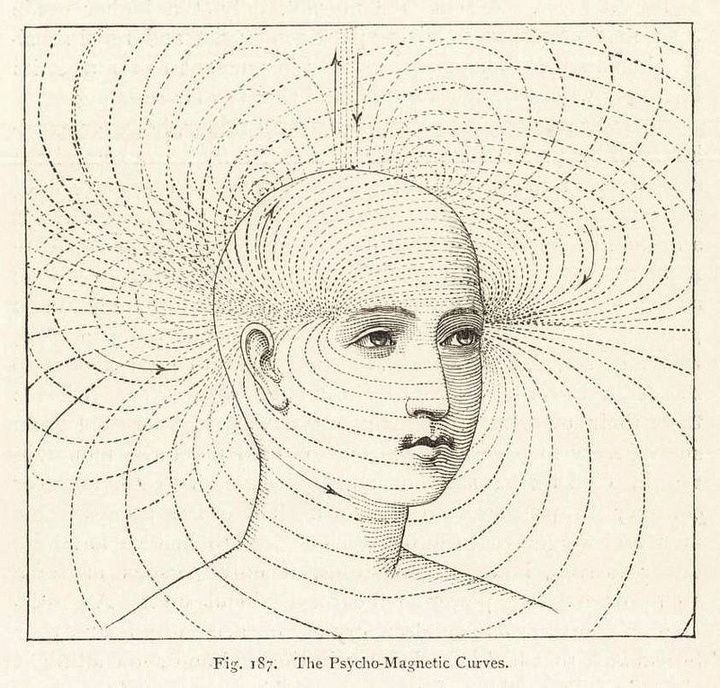
Modern life places unprecedented demands on attention. Notifications compete for awareness, information arrives continuously, and moments of uninterrupted silence have become increasingly rare.
As a result, many people experience a sense of mental crowding—not because they lack intelligence or resilience, but because there is little psychological space in which thoughts and emotions can settle.
Just as physical space allows movement, psychological space allows perspective.
It creates a pause between stimulus and response, enabling reflection before action. This pause is central to emotional regulation, thoughtful decision-making, and meaningful communication.
While interpretations of Akasha vary across traditions, its continued relevance suggests that the idea addresses something enduring in human inquiry:
The relationship between form and emptiness, presence and possibility.
As modern societies grapple with increasingly complex questions about consciousness, attention, and well-being, the ancient notion of Akasha remains a reminder that understanding reality may require us to consider not only what exists, but also the spaces within which existence takes shape.
Read the Panch Mahabhuta Series
- The Creation: A Sankhya Perspective
- Jal: The Water Element
- Agni: The Fire Element
- Vayu: The Air Element
- Akasha: Space, Ether (you are here)
- Prithvi: The Earth Element