
Air (Vayu)
The Element of Movement, Prana, and Inner Expansion
“Air cannot be seen, yet it moves everything
In yogic wisdom , Air is not merely what we breathe—
It is the intelligence of movement that animates life itself.”
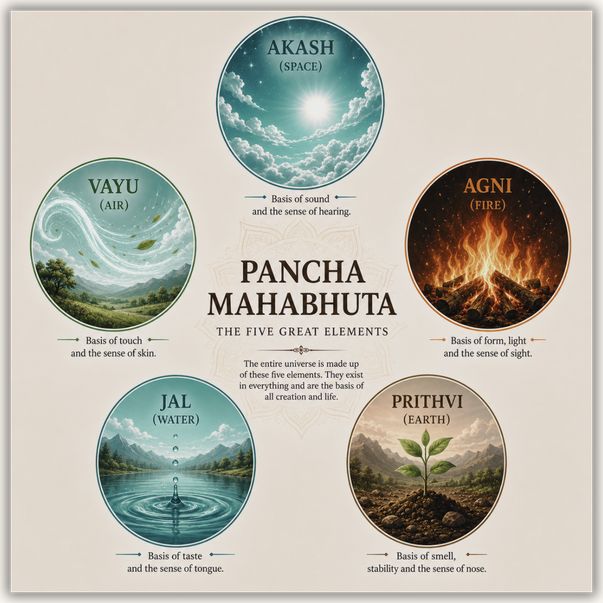
In the yogic sciences, creation is understood through the Pancha Mahabhutas—the five fundamental elements: Earth (Prithvi), Water (Jala), Fire (Agni), Air (Vayu), and Space (Akasha).
These are dimensions of existence that constitute both the cosmos and the human system.
Among them, Vayu (Air) is the principle of movement.
If Earth gives structure, Water provides cohesion, Fire transforms, and Space offers the field of possibility, Air is what enables everything to move within that field.
Without movement, life ceases.
Vayu represents the subtle principle responsible for every movement in creation.
Every heartbeat.
Every nerve impulse.
Every thought.
Every blink.
Every contraction of a muscle.
Every breath.
Movement, whether gross or subtle, is governed by Vayu.
The Five Major Vayus
One of yoga’s most profound understandings is that prana does not move randomly. It organizes itself into five primary movements, known as the Pancha Prana Vayus.
Prana Vayu – The Force of Intake
Located primarily in the chest, Prana Vayu governs inhalation and all forms of receiving. It is responsible not only for breathing but also for absorbing impressions, ideas, emotions, and experiences.
When balanced:
- Vitality increases.
- The mind becomes alert.
- Breathing feels effortless.
Apana Vayu – The Downward Current
Centered in the lower abdomen and pelvis, Apana governs elimination. It is responsible for:
- Excretion
- Reproduction
- Menstruation
- Childbirth
- Releasing physical and emotional toxins
A healthy Apana allows one to let go—not only physically but psychologically.
Samana Vayu – The Force of Assimilation
Located around the navel, Samana governs digestion and integration. Its role extends beyond food. It helps digest:
- Experiences
- Knowledge
- Emotions
Without Samana, one may consume much but assimilate little.
Udana Vayu – The Upward Movement
Centered around the throat and head, Udana governs expression, speech, growth, memory, enthusiasm, and spiritual ascent. It supports:
- Communication
- Creativity
- Higher awareness
Many yogic texts associate Udana with the upward movement of consciousness
Vyana Vayu – The Expansive Force
Unlike the other Vayus, Vyana pervades the entire body. It governs circulation and coordination, ensuring every cell receives nourishment and every part of the body functions harmoniously.
It is the integrator of all movement.
Breath: The Bridge Between Body and Consciousness
Among all bodily functions, breath occupies a unique position.
Heartbeat cannot be consciously stopped.
Digestion cannot be consciously accelerated.
But breath can be consciously altered.
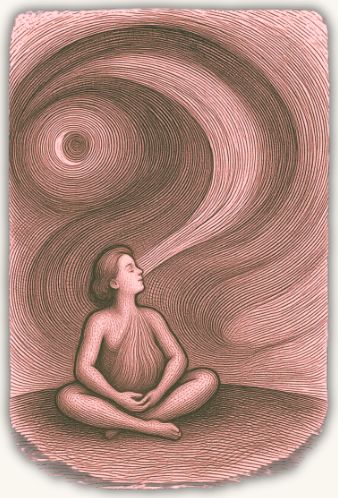
This makes it the bridge between the voluntary and involuntary aspects of our existence.
Every emotional state has a corresponding breathing pattern.
Fear shortens the breath.
Anger heats it.
Grief interrupts it.
Peace deepens it.
Rather than controlling emotions directly, yoga works through breath because breath influences the movement of prana, and prana influences the mind.
Pranayama: Expanding Life Force
Pranayama is often misunderstood as breathing exercises. The word itself tells a deeper story.
Prana = life force.
Ayama = expansion, extension, regulation.
Pranayama is the science of expanding one’s capacity to hold and direct prana.
Practices such as:
- Nadi Shodhana
- Bhastrika
- Bhramari
are designed not simply to improve lung function but to refine the movement of life energy.
Air and the Mind
Yoga observes that the mind rarely becomes still on its own because its movement is sustained by the movement of prana.
Where prana flows harmoniously, thoughts become organized.
Where prana is disturbed, the mind becomes restless.
This explains why even a few minutes of conscious breathing can transform one’s mental state without changing external circumstances.
Master the breath, and the mind begins to follow.
Air and the Anahata Chakra
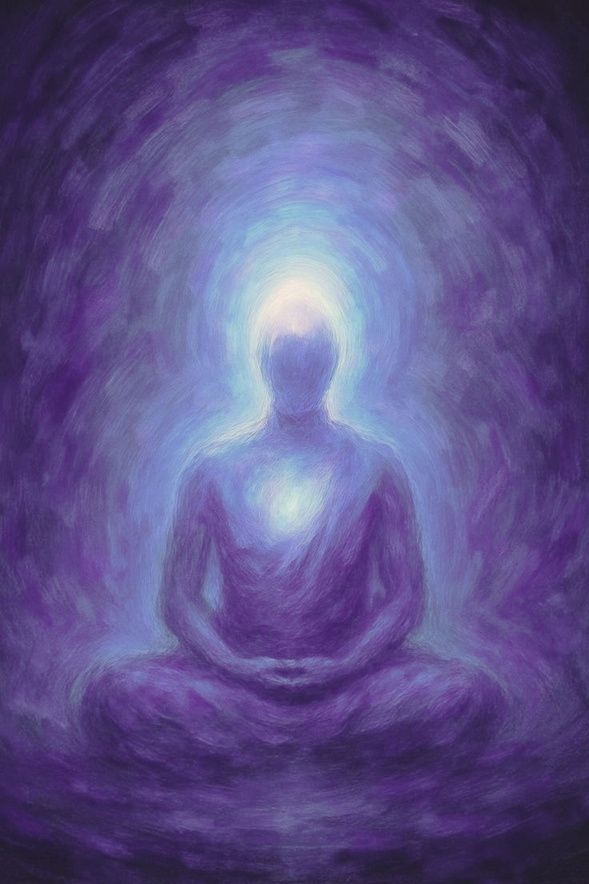
The Air element is associated with the Anahata Chakra, located in the region of the heart.
Anahata represents expansion, compassion, openness, forgiveness, and unconditional love.
Just as air expands to fill every available space,
A balanced heart naturally expands beyond personal boundaries.
When the Air element is disturbed, one may experience emotional constriction, grief, anxiety, isolation, or difficulty connecting with others.
When balanced, there is lightness, generosity, resilience, and effortless connection.
Harmonizing the Air Element
Yoga offers many ways to cultivate balance in Vayu:
- Conscious breathing
- Daily pranayama
- Asana synchronized with breath
- Spending time in fresh natural environments
- Maintaining an upright posture for unrestricted breathing
- Living with emotional openness rather than suppression
- Developing awareness of the subtle movements of prana during meditation
The Wisdom of Air

Air teaches movement without attachment.
The wind passes through forests without possessing them.
Likewise, let experiences move through us instead of becoming trapped within us.
Rigid systems eventually break.
Flexible systems endure.
The Yogic Understanding
Air is the intelligence behind every movement within us.
Every breath is a reminder that life is not something we possess—it is something continuously flowing through us.
To master the Air element is to become so aligned with the movement of life that
effort gives way to Grace,
restlessness gives way to Balance,
& every breath becomes an expression of Conscious Living.
Read the Panch Mahabhuta Series
- The Creation: A Sankhya Perspective
- Jal: The Water Element
- Agni: The Fire Element
- Vayu: The Air Element (you are here)
- Akasha: Space, Ether
- Prithvi: The Earth Element