

The Stories We Finish Too Soon
An Unread Book
“ I once shared with a friend a book I had published under my pen name. The work was an attempt to explore my spiritual quest.
It was my first book and I did everything myself, from writing and editing to designing the cover and creating the blog. I had put something of myself into it. Instinctively, I wanted to share it with people I thought might understand.
Hours later, over a call , he asked what it was about. I had only started to explain when, midway he stopped engaging with the explanation and began with his advice.
His concerns weren’t about the quality of the writing or whether the ideas were coherent. He had neither read the book nor looked at the cover design, yet he felt certain enough to advise me about the direction my life was taking—the social implications as well as the personal ones of the choices I was making.
A conversation that began as
“tell me about this book” quickly turned into
“Let me tell you what kind of person you will become .”
Because the conversation had shifted before he had understood either the book or my intentions, I soon found myself defending an identity he had already constructed rather than discussing the work I had created.
“There is a peculiar loneliness in speaking to someone who is no longer listening to you, but to the version of you that already exists in their mind.”
When a Conversation Ends Too Soon
The conversation unsettled me long after it ended. It had given me neither the feedback I had hoped for nor a conversation about the book itself. Instead, I had felt quietly boxed into an identity I had not chosen.
I eventually understood that the feeling had very little to do with the book.

We never enter a conversation carrying only words. Behind every sentence is a context that cannot be spoken all at once. There are experiences, hesitations, doubts, memories and emotions that quietly shape what we choose to say. We hope the other person will remain with us long enough to sense that unseen background instead of rushing to interpret the sentence alone.
When that doesn’t happen, something peculiar occurs.
We don’t merely feel misunderstood.
We feel unseen.
Next day , When my mind resettled into its calm, I began noticing how often many conversations quietly arrive at this place.
I asked myself
How often do we really meet people as they are, and how often do we simply wait to confirm the version of them that already exists in our minds?
He judged me too early—and I began wondering how often I do the same thing to other people.
The Familiar Stranger
The more I reflected, the more true it seemed that we do not meet people empty-handed.
Every conversation is guided by an invisible archive of memories: of people we have known before, mistakes we have committed or seen being made, disappointments we have endured, patterns we believe we now understand .
A friend says, “I’ve been thinking about changing careers,” and before they have described what has been weighing on them, they are told why it is a mistake.
A woman colleague speaks of retiring early and receives advice before anyone has tried to understand what has led her there.
Someone shares an idea that has quietly changed their existing perspective of things and before the sentence reaches its end, another story has already begun inside the listener’s mind.
The present conversation disappears beneath the familiarity of some older one. The person before us slowly becomes someone we believe we have already met.
The Illusion of Certainity
Certainty seldom introduces itself by its own name. More often, it borrows the language of experience, intuition, discernment, even wisdom
It feels less like prejudice than like seeing clearly.
Once we are convinced we already understand, efforts at discovery quietly leaves the room.
We finish another person’s stories because we are certain we know where it is going. Genuine questions disappear. In their place arrive answers to questions that were never even asked.
I know where this path leads.
I’ve known people like this.
This is how these stories usually end.
The Mirror
Conversations need room to breathe. They ask for two people willing to remain present to one another long enough for meaning to emerge.
The moment we become certain too early, that space quietly disappears. Once certainty arrives, listening quietly changes its purpose. We are no longer listening to discover something we did not know.
We begin listening for confirmation.
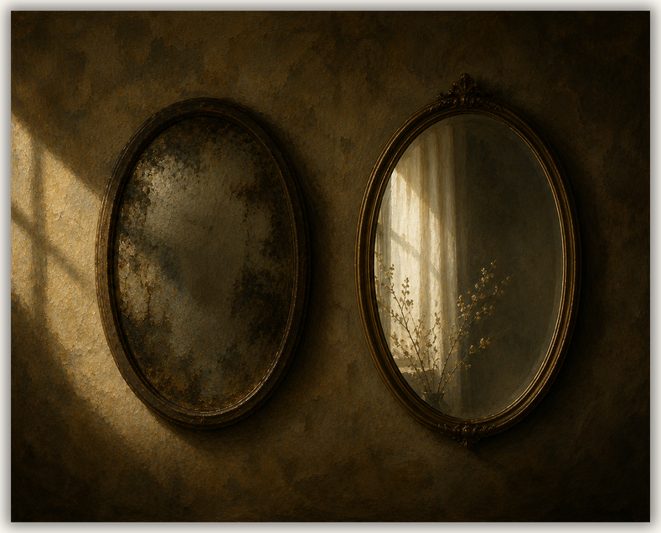
I have come to think of conversation as a mirror held between two people. Curiosity wipes it clean. Patience keeps it clear.
Every assumption, before understanding leaves a faint smudge upon its surface. One or two hardly matter. Yet conversations accumulate, and so do the smudges. Gradually, we no longer see one another. We speak instead to the image we have slowly formed of the other
Tell Me More
One final layer to my understanding was our assumption of entitlements.
When did familiarity become wisdom?
How much of another person’s story have I actually earned the right to interpret?
Do I even listen long enough to earn the entitlement of judgement ?
If I spend time with a book, ask questions about it, understand what shaped it, and only then arrive at a conclusion, that conclusion has been earned through attention.
The same holds for Conversations.
Every life remains partly invisible. I can never fully know what another person has lived through, just as they can never fully know mine. Conversation is perhaps the closest we come to crossing that distance.
The sentence I happen to hear may have been preceded by years of silence. The conviction I encounter today may have emerged from doubts I will never witness. What appears obvious from the outside is often only the final page of a chapter whose beginning remains hidden.
There is a rare generosity in saying, “Tell me more.”
Those three words postpone judgment. Leave the door open a little longer. Allow another life to reveal its own form instead of borrowing one from our recollections.
Every person arrives carrying a story that resembles many others, and yet has never before existed in the world.

To conclude too early is not merely to misunderstand another person.
It is to mistake the limits of my own seeing for the limits of their being.