
Deeper Than Differences
A childhood of many beliefs, a home of many perspectives, and a quiet lesson in what truly holds us together.
Memories
Most of my early childhood was spent at my grandparents’ house. My grandfather was my friend and teacher by day, and at night, I would fall asleep to my grandmother’s stories.
I remember my grandmother’s pooja room more by its atmosphere than by anything I could name in it.
It was a small room, dim even in the morning, because the light that came into it was never quite as bright as the light outside. There were brass and bronze idols placed on a wooden altar, little bowls that were used for water and flowers, incense that left a faint resinous smell in the room. Some mornings I would sit there half-awake, still carrying the heaviness of sleep, listening to the conch she blew as part of her morning prayer. The sound would travel through the house and seem to reach places beyond the room itself.
At that age, I had little understanding of prayer, meditation, energy, vibration or any of the words we use today to describe these things. But simply watching her made me happy .
As pooja was her daily ritual, watching her do it became mine—the “first thing in the morning” ritual.
My grandfather, as I remember him, was the kindest man, but, unlike his wife, he didnot believed much in rituals. He would rather watch his matches, call upon his friends to reminisce about his glorious days, or teach me how to improve my handwriting.
That home was a happy place where I felt Gods chose to reside and faith was celebrated, without being insisted upon.
Later, when we shifted to our own place, my father continued the traditions but in his own ways.
He inherited his mother’s religion in principle, not so much in its practices, though. He would sit at the home temple and read his scriptures, but that was more an act of introspection and contemplation to him.
I saw in him a believer who chose not to perform. He knew his faith deeply, but never felt the need to impose it.
He likes to reason, and so before asking us to adopt a practice, he would usually tell us the reasons and practical aspects of why we do what we do.
So religion entered my life- not through books or priests, but from watching people around me.
Nothing was forced, yet everything got learned.
Belonging
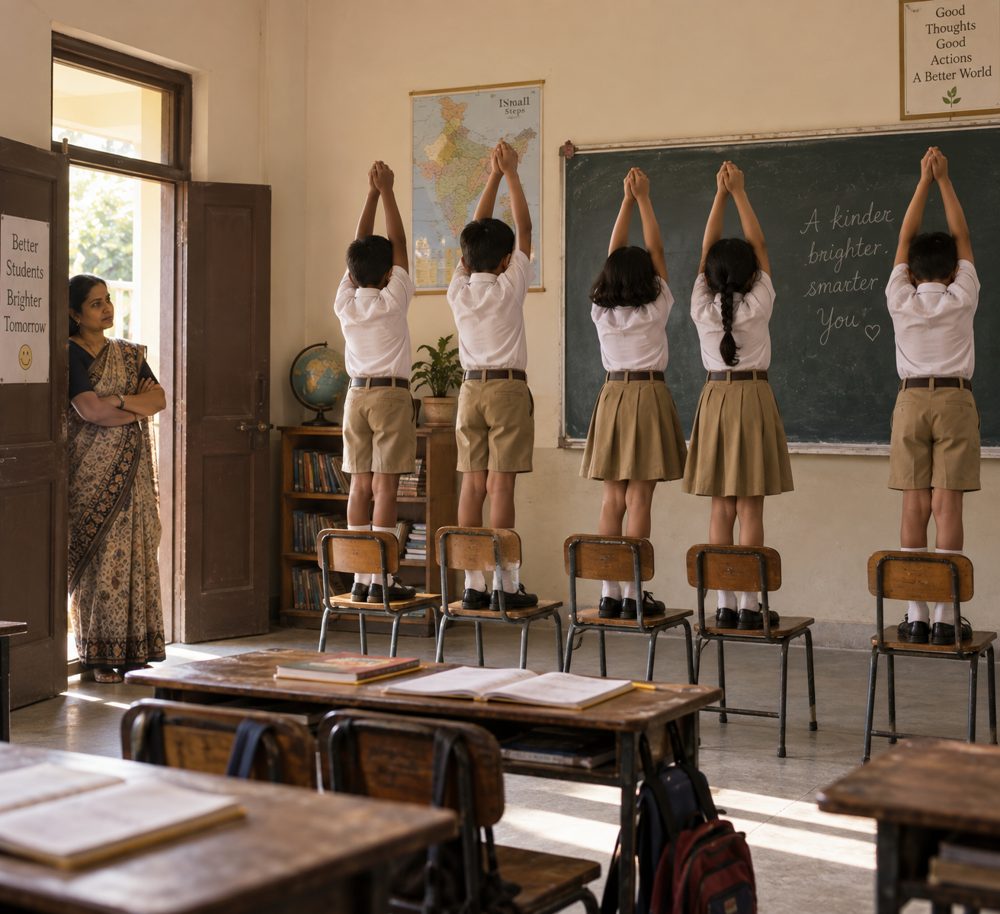
I shifted schools often as a child, and the longest duration I stayed, was at a beautiful small school which had the most amazing confluence of teachers and students.
My class was a beautiful bouquet of people belonging to all major religions in India, and since I hail from Lucknow, we had a lot of children who followed Islam.
However, the topis, the taqiyas and the hijabs -all stayed outside the school gates, and nobody seemed to mind.
Inside, we were simply classmates.
We studied, played, laughed, goofed around, got punished—all as a team.
We belonged to that place, and that place belonged to us all—equally.
The teachers protected us. The staff cherished us, and the management encouraged us. That was all we needed then.
Because religion was rarely discussed as a dividing line, either back home or in school, we never learned to look for one.
Whatever our personal beliefs at home, that place taught us to accept the differences and celebrate them.
Staying there long enough made me realise tolerance is not same as acceptance.
Tolerance can still keep a distance; acceptance makes space.
When Things Change
Fast forward to the present day: same city, familiar faces; but the atmosphere feels so heavy.
I now hesitate to invite my Muslim friends over at my place. We don’t have those get-togethers anymore. I miss her Ammi’s delicious cooking, her father’s generous blessings. And to this day, my father still remembers the box of sewaiya my friend used to bring especially for him during Eid.
Some days, I look back and think of the elders I grew up admiring—people whose faith was visible in the marks they wore on their faces, the prayers they offered, the way they lived their dharma. Their devotion was never something we questioned. If anything, it was something we respected.
I sometimes wonder what it must feel like today, when something like religion-so deeply personal and powerfully sacred, can no longer be expressed without hesitation. Something that once inspired respect can now invite suspicion, anxiety or mistrust.
I often worry for those who will grow up normalising this fear. The kindness I experienced as ordinary may one day feel extraordinary to someone growing up today.
Religion,I always believed is the relationship between an individual and what they hold sacred.
And as deeply as my own faith may matter to me, I cannot see why that should leave me with anything but respect for another person who holds theirs with the same sincerity.
Agreeing to Disagree
Growing up, my sister was really annoying. We were too different.
Different preferences—in food, clothing, lifestyle and whatever one can imagine—and yet we were forced to live together. Not a day went by, without arguments.
But anytime ,these complaints reached my father, he neither got angry nor rebuked us. All he had to say was:
“You don’t agree on much. You don’t have to.
But we are still family.”
The bond is already rooted in something deeper than the differences.”