Convenience and Conscience
A personal reflection on AI, modern comforts and the quiet costs we rarely see, and what it means to live with the questions.
The Arrival
Months before AI became commonly accessible, I remember I was introduced to it by a tech-geek friend of mine, who asked me to try a new form of bot chatting. Next thing I knew, within a year, artificial intelligence had become the new buzzword..
It was helping hundreds of thousands of people become more efficient. Days’ worth of work were getting done within minutes. Something so powerful and magical seemed to have arrived, and was so easily accessible to all.
I distinctly remember when AI image-generation tools were launched. Social media platforms experienced a massive wave of users generating Studio Ghibli-style portraits and landscapes using generative AI tools and prompt models. While the internet flooded with machine-generated artwork, the real artists got cornered. Copying was easy for a machine, but it took a lifetime of learning to master that skill. When Hayao Miyazaki, the co-founder of Studio Ghibli, remarked that true art requires the deep, agonising human effort and soul of the artist, which a machine cannot feel, I realised the pain of losing in minutes what took a lifetime to build.
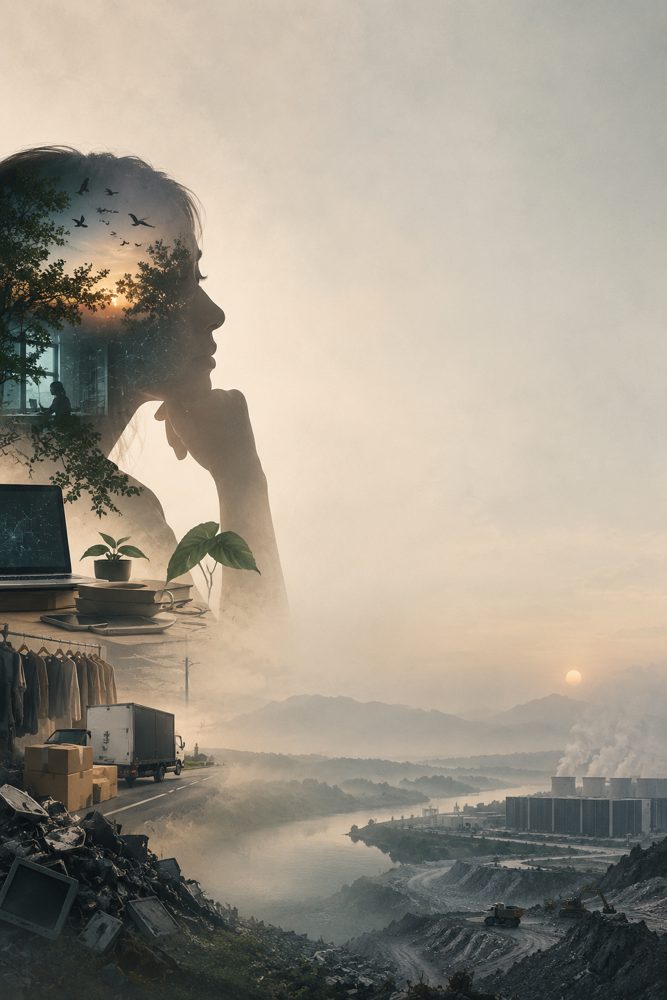
It is impossible to use AI today without eventually encountering the questions that surround it. Some speak of the enormous energy required to sustain it. Others point towards the water consumed by vast data centres, the minerals drawn from the earth to build ever more powerful machines, the invisible workforce that labels data or filters disturbing content, the livelihoods that may disappear as automation advances, and the widening distance between those who build these systems and those who simply become dependent on them.
I do not know where every debate will end. Some claims will be challenged, some technologies will improve, and some fears may prove exaggerated. But I cannot honestly tell myself that the convenience I enjoy arrives without consequence.
I know enough to know that something is being exchanged.
And still, I return to AI and its competencies. These revisits made me realise it’s not the first time I am contradicting my own self.
I have seen it in the phone I replace every few years without wondering where the old one ends up. In next-day deliveries that somehow make distance disappear, while someone else pays the price for that speed. In clothes I buy much more than I need that end up choking parts of the earth.
The pattern repeats itself so often that it begins to feel like a characteristic of being human.
The Distance
Perhaps we have always lived this way.
Every civilisation has found ways to separate benefit from consequence. We enjoy what is close to us and slowly lose sight of what has been pushed farther away. The farther a consequence moves from our everyday experience, the easier it becomes to live as though it does not belong to us.
Convenience depends on this distance.
If every question I asked AI required me to stand beside a data centre, watch rivers diverted for cooling, meet the workers who spend their days filtering disturbing content, or visit the mines that produce the minerals inside our machines, I suspect my relationship with technology would feel very different.
Distance allows convenience and consciousness—both—to remain clean. It removes the friction that might otherwise slow us down.
The suffering we witness directly can alter us. The suffering hidden behind systems becomes an idea. We acknowledge it, discuss it, perhaps even feel disturbed by it, but our daily habits remain almost untouched.
Maybe our minds were never designed to carry the emotional weight of every invisible consequence attached to modern life.
And yet that explanation misses something.
If consciousness only reaches as far as what is visible, what does that say about the kind of consciousness we celebrate?
We often speak of awareness as though it is a moral achievement. But awareness that never asks anything of us is remarkably easy to possess.
It costs very little to know.
It costs much more to live differently.
I wonder if that is where convenience quietly changes us.
Most people are not careless. They are simply trying to live, work, care for their families, meet deadlines, and keep pace with a world that rarely rewards slowness.
The Habit
Convenience offers relief, and relief is difficult to refuse.
Not that I feel guilty every time I open AI.
Neither do I feel innocent.
I find myself somewhere between the two, trying to understand what it means to live consciously in a world where almost every comfort seems connected to a cost that someone, somewhere, is quietly carrying.
Maybe there is no simple answer.
But I have begun to think that the first responsibility of consciousness is not certainty.
It is refusing to let convenience erase the questions.
Convenience is difficult to recognise while it is entering our lives.
It never threatens to take over.
It offers help.
Less effort.
Better result.
A smoother day.
Nothing feels significant enough to question.
Then one morning we wake up and discover that an accessory is now necessary. We no longer question a convenience that has converted to habit.
I sometimes wonder how many things I now call necessities that began as conveniences.
Perhaps every generation experiences this without noticing.
The first electric light.
The first automobile.
The first search engine.
The first smartphone.
The first AI conversation.
Each one enters as an addition. Each one slowly changes the meaning of ordinary life. Refusing them becomes possible in theory and increasingly difficult in practice.
That is the place where my questions begin.
The Question
People often say that consciousness is about becoming aware.
I am no longer certain.
Awareness can exist quite comfortably beside habit. I know this because I watch it happen within myself. I do not forget the questions. I simply continue living with them. They become familiar enough that they stop interrupting the next decision.
Some days it still troubles me how quickly the mind learns to carry a contradiction without allowing it to disturb the rhythm of daily life.
Maybe that is why information changes so little.
We keep believing that another report, another documentary, another statistic, another article will finally awaken us. Yet I have never lived in a time where knowledge was easier to find, and I have never seen so many people, myself included, continue living almost exactly as before.
The problem may not be that we know too little.
It may be that knowing and living are separated by a distance we rarely acknowledge.
I still use AI.
I will probably use it tomorrow.
I cannot pretend otherwise.
This essay is not an attempt to defend that decision or condemn it. It is simply an attempt to remain honest about the space between what I understand and what I actually do.
I have begun to think that consciousness is not a destination we arrive at through knowledge.
It is the willingness to remain in the presence of uncomfortable questions without rushing to silence them.
Some questions just stand at their place quietly, and it is upon us not to drop them into the background of more flashy things.