
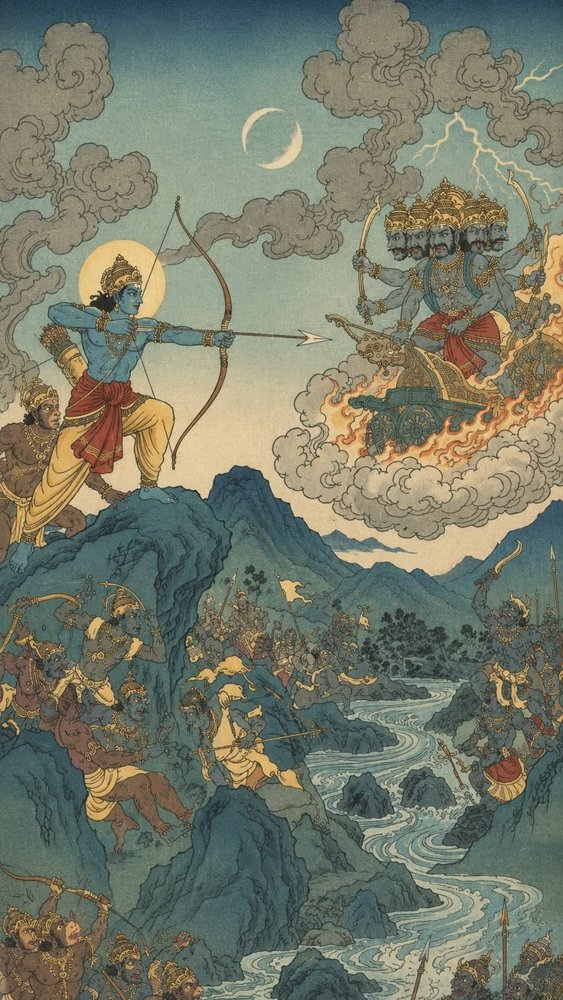
Power Without Restraint: The Fall of Ravana
Why did Ravana have ten heads? A conversation
Before We Begin
This series is not a literary debate or an attempt to establish mythological or historical claims.
Rather, it is an inquiry by someone who inherited these stories, as many of us did, and later found herself filled with questions—questions to which her elders often had no satisfying answers.
After many years, returning to these epics, reading them again, observing life around me, and asking what they were really trying to preserve, some of those questions began to unfold in new ways.
These essays are an attempt to think aloud about the answers I found in retrospect
It is not an attempt to tell you what to believe, but an invitation to reflect. Perhaps these reflections will resonate with some readers, challenge others, or simply inspire new questions of their own. If they do, then these conversations will have served their purpose.
About the Conversation
Throughout these essays, two voices appear.
? The Seeker
One who asks—the curious mind that inherited these stories.
The Knower
One who reflects—not with final answers, but with observations that emerged over time.
Together they explore questions inherited from stories that continue to shape us.
The Seeker
Who was Ravana? Why did he have ten heads ?
The Knower
The visual language of Indian iconography is deeply symbolic.
– It was to make patterns visible from far away.
Multiple heads in art usually mean multiple faculties running in parallel.
Raavaṇ was the son of the revered sage Vishrava (a Brahmin) and the Daitya princess Kaikesi (a Rakshasa). This mixed heritage gave him the lineage of a Brahmarakshasa.
He was the mighty king of Laṅka, a brilliant scholar, master of the Vedas, a musician, a devotee of Shiva, a fearsome strategist.
The “ten heads” is showing his extraordinary capacity.
The Seeker
Despite such learnings , why did he kidnap Sita
-knowing she was the wife of Rama?
The Knower
Because Intelligence is not a cure.
It is only the AMPLIFIER.
Whatever sits at the core of a person- it multiplies it .
Raavaṇ’s problem was not ignorance. It was pride.
He had been humiliated earlier by celestial beings, who envied his rise. His penance earned him so many boons that he soon became used to a world where no one could refuse him.
When he saw Sita, he wanted her . Knowing well she was the devoted wife of the mighty king of Ayodhya
Seeta was not just his desire. She became proof.
-that he could take what even the gods protected.
His power was his permission .
His ego edited out limits.
The Seeker
Was he warned?
The Knower
Oh! Constantly.
- His brother Vibhishan begged him to return Seeta
- His wife Mandodari adviced him the same,
- His ministers warned him of Raam’s nature.
- Even omens in the story turn hostile.
But ..intelligence and ego are different species.
Intelligence says “This will destroy me”
Ego says: “I will be the exception.
The Seeker
Why did he ignore everything?
The Knower
Because the ten heads argued with each other…
and ego was chairing the meeting.
The epics are blunt about this:
Raavan could conquer worlds, but not the small inner territory called restraint.
The Seeker
What happened next ?
The Knower
War. Collapse. Death.
as a structural consequence:
A ruler who placed personal obsession above cosmic order (dharma) eventually turned his kingdom into collateral damage.
Lankaa burned because one man’s obsession became an entire kingdom’s destiny.
The Seeker
Why is Ravana remembered differently ?
The Knower
because each civilisation chose differently.
- In North Indian tradition- he is archetypal villain of pride.
- South Indian & some shaiva traditions he is a tragic genius, great devotee ruined by one flaw.
- Modern literature: symbol of the brilliant mind destroyed by its own blind spot.
he is remembered as the great and wrong at the same time.
The Seeker
What makes SriRaam win ?
The Knower
Sri Raam is shown as the most aligned and least internally fragmented character in the epic.
- he gives up his kingdom when duty asks,
- he obeys even unfair obligations,
- he fights only after negotiation fails,
- he never claims exemption from the rules he expects others to follow.
Raam keeps allies because people trust him.
Trust is the consequence of restraint
The Seeker
Its a beautiful epic. But the times are different now
.How is it any relevant today ?
Why do we continue reading and transmitting them ?
The Knower
To teach consequences .
The characters still live through the traits they embibed.
Raavan is maximum capability, minimum self-regulation and
Ravana represents power that answers only to itself.
Raam represents power that first submits to restraint.
Most of us have some traits of each character within us . These stories serve as mirrors- to see and know.
The Seeker
Is Ramayan condeming power through Ravana ?
The Knower
No
the Raamayan is not condemning power.
It warns against unchecked power
It is saying:
“Brilliance without restraint becomes dangerous faster than ignorance ever could.”
Ten heads.
One unchecked desire.
That imbalance is the real villain.
Ravana was exceptional brilliance and yet one mistake became his undoing.
The Seeker
If Dharma or righteousness in conduct is what Bharat sought to preserve through Rama, why does it equally revere Krsna. Krsna ,who seemed guided more by context and consequences than Dharma alone. Why does the same civilization hold Rama and Krishna as equal ideals when they seem to represent different approaches to dharma?
…. To be Continued in next essay
Questions We Keep
If my questions resonated with yours, I invite you to my booklet, where I have gathered this whole conversation, with some more surprises.
I would love for you to sit with them a little longer.
Coming soon on Kindle
From the Akaayati Reflections Series
© Akaayati, 2026
These essays are original reflections on Indian epics and civilizational thought. Please share with attribution.