THE MYSTIC AND THE SEEKER
“I stand at the threshold, looking in both directions.”
Having spent enough years in the world to understand something of its promises and disappointments, I can claim to have watched and chased the pursuit of pleasure, achievement, identity, and meaning in countless forms. Yet nothing seemed capable of providing the permanence it promised. Some days, I feel a deep pull to explore beyond the familiar cycle of everyday living, but I hesitate.
Unfamiliarity creates both – scepticism and undefined fear.
.….
It wasn’t very long ago that I was actively seeking seekers and those we call the realized souls. They speak of grace, awakenings, and self-realization. Their descriptions differ, but the conviction behind their words is difficult to dismiss. They all sound like people describing something lived. They knew something, and I wanted to know it too, but…
Human experience is so vast that it seems unlikely, everything worth knowing must fit within the limits of my own experience or imagination. There was always a distance between their experiences and my understanding of them.
Knowing that something may exist and absorbing its reality, is not the same. I still lacked an experience of my own to place beside theirs, which could have helped me to absorb the depth of their words better. I could not pretend the understanding and decided to wait.
…..
Further on this journey, I found myself introduced to the Vāk Sūktam. The speaker of this hymn, a female sage (the Ṛṣikā), speaks in the first person:
“I move among the gods.”
“I sustain the worlds.”
“I am the sovereign power.”
She is not praying to the divinity but claiming herself as the divine reality.
I was fascinated by her words, but acknowledged the limitations of my understanding and stopped. I was seeking something. I knew not what it was and something that seemed to hold an answer was still being a puzzle. I wanted to give up and almost did.
This hymn kept appearing and re-appearing to me at different places: as a song, as an article, as a recitation on the radio. Nothing clicked still.
The words sounded profound, but I could not relate. Months later it showed up again. For some reason, this time, I felt the pull and wished to know it better. To learn more about it, I spent days the many reading translations and interpretations, but always something felt amiss. Carrying it with me as someone else’s translation seemed insincere; it was asking for a deeper understanding from me.
I decided to wait for it to reveal itself.
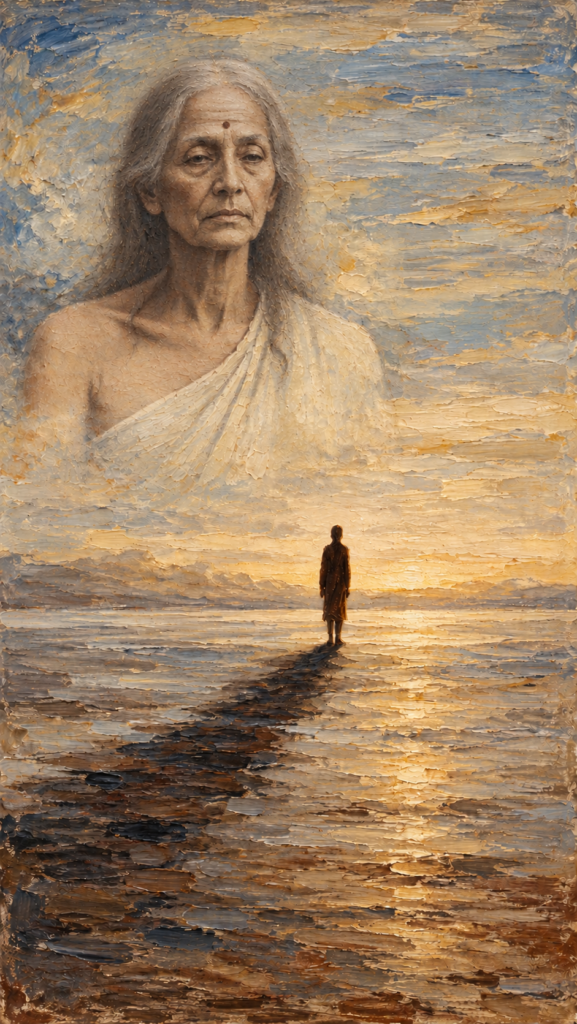
Perhaps my struggle was seen. Some time later, I stumbled upon an article about Lal Ded, or Lalleshwari, the revered mystic saint of Kashmir Shaivism. Ages separated her from the Ṛṣikā (composer sage) of the Vāk Sūktam, yet something about both voices felt familiar. Tradition says Lal Ded was married young, experienced a difficult domestic life, and eventually left home to devote herself entirely to the spiritual inquiries and eventual realizations. She became a wandering mystic, who expressed her insights as short poetic utterances known as Vakhs (“speech” or “utterances”).
Her poetry is not philosophy explaining the outer world; it is consciousness speaking from within itself.
She wrote with the same certainty that I had found in the Vāk Sūktam.
Someone who writes because she knows.
This familiarity intrigued me. I re-visited the Vāk Sūktam. It always knew I was coming back..
…..
Mentioned in the Rig Veda (10.125), the Vāk Sūktam, also known as the Devī Sūktam, is attributed to the Ṛṣikā Vāk Ambhṛṇī, daughter of the sage Ambhṛṇa.
This Atma-Stuti is a bold declaration of sovereignty by the Ṛṣikā in a state of communion with Brahman. The Vāk Sūktam is among the oldest surviving testimonies of such realizations. Call it by whatever name: theology, philosophy, or mysticism, what pulled me was the possibility it presented.
What was it that allowed the Ṛṣikā to look upon the many powers of the world and perceive a single reality behind them?
What was it that allowed her to identify herself not with one fragment of existence, but with the force expressing itself through all of them?
What was seen that made such language seem natural?
The more I reflected on the hymn, the less interested I became in the competing interpretations. I was interested in the experience that may have preceded the Vāk (the sacred utterance).
The verses tell us what was said; no one knows what was seen.
The verses hint at a possibility; where a human being could experience something so profound that the separation between self and world, individual and cosmos, appears to fade. One sees oneself as the ultimate cosmos. These verses are full of bold and unhesitant declarations.
….
Whether that possibility is spiritual, or symbolic, I cannot yet say. What I do know is that the Vāk Sūktam has become, to me, one of the most remarkable expressions of the highest possibility a human experience seems capable of reaching.
This inquiry into the Vaak Suktam is a humble attempt to stay a little longer with the questions, to explore them, and to discover what can be learned from the act of inquiry itself.
…..
This piece is the prelude to the book: Vak Suktam – A Reading, where the inquiry continues through the hymn itself. Available on Amazon.com